- Home
- About Us
About Us

- Products
Products
- Application Industry
Application Industry
- Services
- Cases
- Blog
Blog
- Contact Us


- Default Language
 EN
 RU
 ES
 DE
 EL
 IT
 JA
 KO
 PT
 ID
 SR
 UK
 VI
 TH
 TR
 MS
 BE
 AR
Best-Selling Work Gloves in South America: Top Products and a Complete Buying Guide
Introduction: Choosing the Right Work Gloves for South America
South America has diverse industrial and commercial markets, with demand for personal protective equipment (PPE) across construction, agriculture, mining, manufacturing, warehousing and logistics.
For importers, wholesalers and PPE distributors, choosing the right work gloves means balancing protection, comfort, durability and purchasing cost.
There is no single best gloves for every application. A distributor serving construction workers may prioritize affordable, abrasion-resistant gloves, while a mining supplier may require cut-resistant gloves with stronger grip and additional protection.
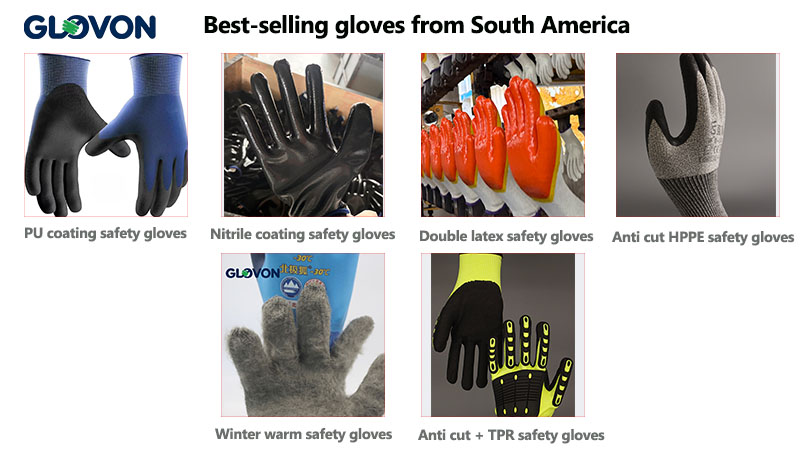
6 Popular Work Gloves to Consider for the South American Market
1.PU-Coated Work Gloves: A Cost-Effective Choice for General Handling
PU-coated gloves are widely used for general assembly, warehousing, packaging, electronics handling and light industrial work.
Their thin polyurethane coating provides a smooth surface and good dexterity, allowing workers to handle small components with precision.
Key advantages:
A.Lightweight and comfortable for extended wear.
B.Good finger flexibility and tactile sensitivity.
C.Suitable for precision handling and light-duty applications.
D.An economical option for distributors supplying general-purpose PPE.
Recommended applications: Electronics assembly, packaging, warehouse operations, inspection and light manufacturing.
Buying tip: Compare liner gauge, coating consistency, sizing and abrasion resistance. PU gloves are not automatically suitable for oily environments or heavy-duty cutting tasks.
2. Smooth Nitrile-Coated Gloves: Practical Protection for Industrial Work
Smooth nitrile-coated gloves are a useful option for general industrial handling where resistance to oil and abrasion is important.
Nitrile coatings can offer better performance when handling certain oily components, depending on the coating formulation and glove construction.
Key advantages:
A.Good abrasion resistance in suitable designs.
B.Useful for handling components with light oil contamination.
C.Suitable for maintenance, assembly and general industrial applications.
D.Available in different liner gauges, coating thicknesses and cuff styles.
Recommended applications: Automotive workshops, machinery maintenance, metalworking and general manufacturing.
Buying tip: Smooth nitrile coatings are not ideal for every wet or oily task. Buyers should evaluate grip under actual working conditions and confirm chemical compatibility when chemical exposure is involved.
3. Double-Dipped Latex safety gloves: Enhanced Grip for Demanding Work
Double-dipped gloves feature two coating layers designed to improve coverage, durability or grip.
Some models combine a smooth inner coating with a textured outer coating. Others use different coating designs to balance flexibility and protection.
For distributors serving construction, agriculture, outdoor maintenance and general industry, double-dipped gloves can be a valuable product category.
Key advantages:
A.Potentially improved coating coverage and wear resistance.
B.Better grip when the surface texture is designed for the application.
C.Suitable for selected heavy-duty handling tasks.
D.Available in different liner materials and coating finishes.
Recommended applications: Construction, agricultural handling, outdoor maintenance and industrial material handling.
Buying tip: Check whether the glove is fully coated or palm-coated, and compare its grip performance, flexibility and coating durability. Latex may also cause allergic reactions in some users.
4. Cut-Resistant Gloves: Protection for Metalworking and Manufacturing
Cut-resistant gloves are essential for jobs involving sharp edges, sheet metal, glass or other cutting hazards.
They commonly use HPPE, aramid or other engineered fibers, sometimes combined with steel or glass fiber. The palm may feature a PU, nitrile or other suitable coating.
Key advantages:
A.Available in different certified cut-protection levels.
B.Can combine cut protection with abrasion resistance and grip.
C.Suitable for industrial tasks where hand injuries are a concern.
D.Different liner gauges allow buyers to balance dexterity and protection.
Recommended applications: Metal fabrication, automotive manufacturing, glass handling, machinery production and selected mining-related tasks.
Buying tip: Never select a glove based on the phrase “cut-resistant” alone. Request relevant test reports and compare the applicable EN 388 or ISO 13997 results with the actual workplace hazards.
5.Double-Dipped Winter Gloves: Warmth and Grip for Cold Conditions
For workers exposed to cold weather, outdoor handling or refrigerated environments, insulated gloves with suitable protective coatings can offer a practical combination of warmth and grip.
Long-pile or brushed liners help retain warmth, while a double-dipped palm can improve coating coverage and grip when properly designed.
Key advantages:
A.A warmer liner for selected cold-weather applications.
B.Coated palms for improved handling and grip.
C.Options for different coating textures and levels of coverage.
D.Suitable for seasonal product ranges offered by PPE distributors.
Recommended applications: Outdoor construction, cold-weather logistics, agricultural work and selected refrigerated operations.
Buying tip: South America includes both warm and cold climates. Choose winter gloves according to the specific destination, season and working environment rather than assuming the same product fits the entire region.
Contact with us to discuss more details :
whatsapp/wechat :+8617888367167
Email :veraglovon@zohomail.cn veraglovon@outlook.com
About Us
products
Business
News
Contact Us
Service Hotline:0086-17888367167WhatsApp: +8617888367167
Email: veraglovon@zohomail.cn
Address: No. 249 Tiejueshan road ,huangdao District, Qingdao City,shandong province,China